

CASE STUDY: Skill-Related Adaptive Modifications of Gaze Stabilization in Elite and Non-Elite Athletes
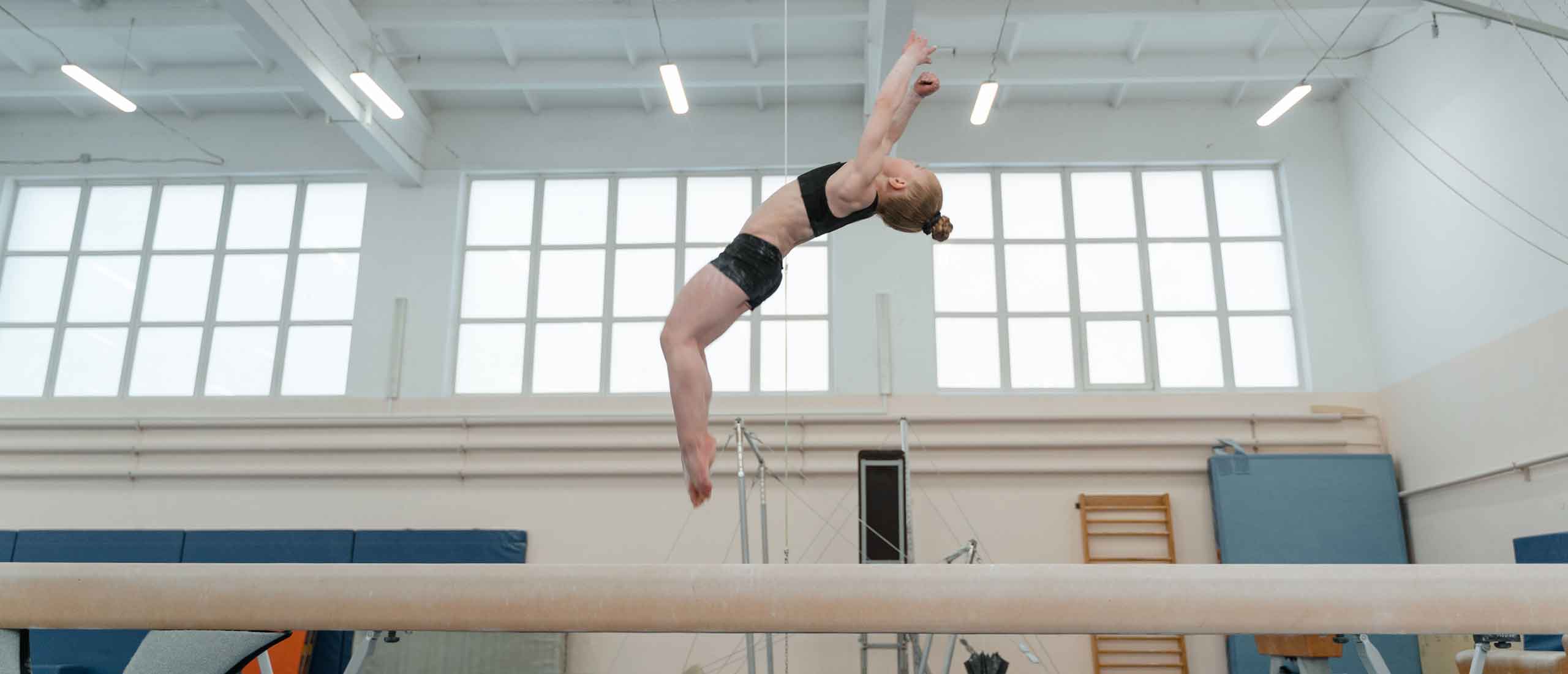
When an aerial acrobat flips and twists mid-air, maintaining visual control of the landing target is critical for safety and success. The vestibulo-ocular reflex (VOR) is an involuntary neurological mechanism that stabilizes vision during head movement by driving eye movements in the exact opposite direction of head motion. However, during complex aerial rotations, suppressing this reflex—known as VOR suppression—allows athletes to bring target landing zones into view much faster. A study published in Frontiers in Sports and Active Living by Susanne van der Veen, Alexander Stamenkovic, James Thomas, and Peter Pidcoe investigated whether long-term athletic training alters gaze stabilization mechanisms.
Researchers evaluated whether skill level correlates with gymnasts’ ability to manipulate gaze stability during classic VOR and VOR suppression tasks.
Tracking Gaze During Head Movements
The study tested 13 female gymnasts spanning a spectrum from novice to elite experience, categorized using the USA Gymnastics Junior Olympic Development Program levels (ranging from Level 5 novices to Level 10 elite athletes). Binocular eye movements were recorded using an EyeLink II eye tracker operating at 250 Hz. Head kinematics were tracked concurrently using electromagnetic sensors, allowing the researchers to calculate VOR gain—the ratio of eye movement velocity to head movement velocity.
Participants completed two distinct visuomotor tasks across seven metronome-guided head movement speeds:
- Classic VOR Task: Participants fixated on a stationary central target while actively rotating their heads horizontally.
- VOR Suppression Task: Participants visually tracked a head-mounted target created by a laser pointer, requiring them to suppress reflexive VOR counter-eye movements.
Results of Vestibulo-Ocular Reflex Degradation and Surpression
- Classic VOR Degradation: Across all experience levels, standard VOR performance degraded similarly at higher head movement speeds. VOR degradation refers to the eye tracker measuring an eye velocity that falls short of fully matching the head velocity as rotation speeds increase. This means that at fast speeds, the eye’s automatic counter-rotation becomes less efficient for everyone, regardless of athletic skill.
- Superior VOR Suppression in Experts: During the suppression task, elite gymnasts (Levels 9 and 10) maintained VOR gains near zero across speeds. In gymnastics, athletes want a VOR gain of 0 during complex flips and twists because keeping their eyes moving in tandem with their head allows them to suppress the automatic counter-rotation reflex, thereby bringing the landing surface into their field of view much faster to confirm a safe landing. In contrast, novice gymnasts demonstrated higher variability and struggled to suppress VOR, deviating significantly from optimal suppression. As context, a VOR gain of -1 indicates perfect standard VOR counter-rotation, while a gain of 0 represents perfect suppression where the eyes move in tandem with the head.
These results demonstrate that gaze stabilization mechanisms are adaptable through targeted training. While basic VOR reflex limits affect all athletes at high speeds, elite acrobats acquire context-specific control to suppress VOR on demand. Beyond sports science, understanding VOR suppression offers valuable insights for designing vestibular rehabilitation protocols for individuals suffering from concussions, traumatic brain injuries, or balance impairments.
The Key Takeaway
Elite athletic performance isn’t just about muscular power; it relies on fine-tuned neurological adaptations. High-precision EyeLink eye tracking tools allow researchers to measure subtle visuomotor modifications, showing that VOR suppression can be trained to optimize performance under complex dynamic conditions. The EyeLink 3 records both eye and head velocities at up to 1000 Hz, making it the perfect tool for further research into this topic.
For information regarding how eye tracking can help your research, check out our solutions and product pages or contact us. We are happy to help!